How to Fix Your AI Visibility: The 5 Things Local Businesses Need to Change
ChatGPT recommends just 1.2% of local businesses. Here are the five practical things Australian trade, health and service businesses can change right now to be one of them.
Most local businesses are invisible to AI search. Not because their business isn't good enough, but because their digital presence wasn't built for the way people are finding businesses now.
Here's the number that should get your attention: according to SOCi's 2026 Local Visibility Index, which analysed over 350,000 business locations, ChatGPT currently recommends just 1.2% of local businesses. Google's local results, by comparison, show 35.9% of locations. AI visibility is up to 30 times harder to achieve than a Google ranking, and most businesses haven't even started working on it.
The other thing worth knowing: a strong Google ranking does not automatically mean AI visibility. Research from the same index found that in retail, fewer than half the businesses performing well in traditional local search also appeared in AI recommendations. Your Google ranking and your AI visibility are two separate things, measured in two separate places.
What actually wins now is specificity: A website that tells an AI agent exactly what you do, who you serve, and why you, in the first few seconds of reading it.
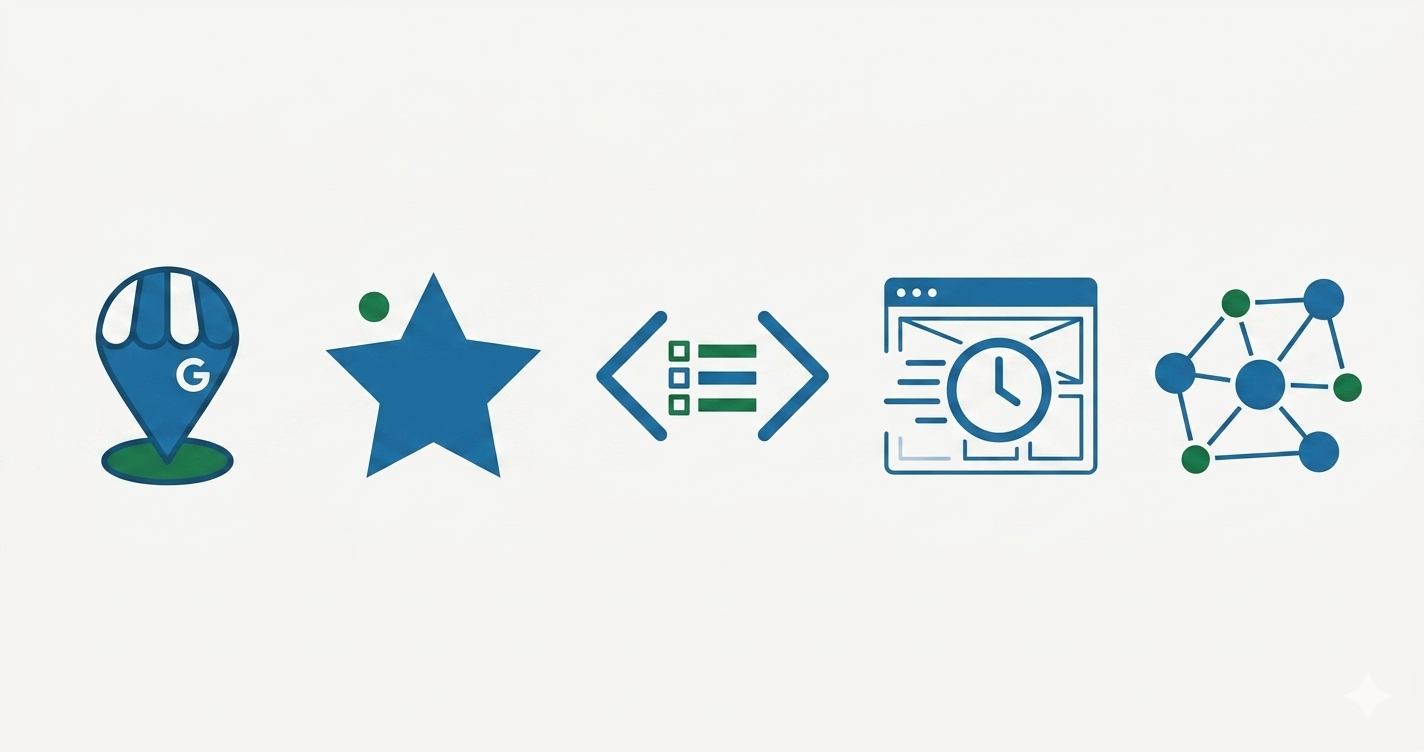
Here are the five things you can change.
1. Get your Google Business Profile complete and current
If you want to show up when someone asks ChatGPT, Gemini, or Google AI for a local recommendation, your Google Business Profile is the foundation everything else builds on.
Gemini grounds its local recommendations directly in Google Maps data, which means businesses with complete, accurate profiles have a significant head start. And the gap between platforms is real: business profile information was found to be only 68% accurate on ChatGPT and Perplexity, compared to 100% accuracy on Gemini, precisely because Gemini pulls directly from Google's own data.
What complete looks like: every service listed individually, your service area defined clearly, opening hours current, photos added in the last 90 days, and your business description written in plain language that explains what you do and who you help. Not keywords stuffed into a sentence. Actual plain language.
The businesses that pull ahead in AI recommendations tend to be the ones with strong ratings and complete profiles. Weak data and poor sentiment are the two most common reasons businesses fail to appear.
2. Sort out your reviews, including the words in them
Most businesses think about reviews in terms of star ratings. AI systems read them like a document.
When someone asks an AI tool for a recommendation, the AI is not just checking your average score. It is reading the text of your reviews to understand what you actually do, who your customers are, and whether the experience matches what your website claims. Reviews that mention specific services, locations, and outcomes give AI the language it needs to recommend you accurately.
Use of AI tools to find local businesses has jumped from 6% to 45% of consumers in a single year, according to BrightLocal's 2026 Local Consumer Review Survey. That is not a slow trend. That is a channel that has already arrived.
A few practical moves: ask customers to mention the specific service they had done and the suburb they are in when they leave a review. Respond to every review, including negative ones, promptly and in your own words. Review responses are now a confirmed ranking signal, and the 2026 Whitespark Local Search Ranking Factors report confirms that engagement and behavioural signals are gaining weight in local rankings.
One more thing worth knowing: trust in reviews has dropped. In 2020, 79% of consumers trusted reviews as much as personal recommendations. By 2025, that figure had fallen to 42%. Authentic, specific reviews from real customers matter more than ever precisely because generic ones are losing credibility.
3. Add structured data to your website
This is the most technical item on the list, and the one most local business websites are missing entirely.
Structured data is code added to your website that tells search engines and AI systems what your content means, not just what it says. Without it, an AI reading your website has to interpret your content and make inferences. With it, the AI knows exactly what business you are, what services you offer, where you operate, and how to contact you.
For local service businesses, the two most important schema types are LocalBusiness and Service. LocalBusiness schema should include your business name, address, phone number, service area, and opening hours, and it should match your Google Business Profile exactly. Inconsistencies between your schema and your GBP listing confuse AI systems and reduce the confidence with which they will cite or recommend you.
The practical impact is significant. Structured data is the most underestimated technical investment available to small businesses right now, and for service businesses specifically, correctly implemented schema has been shown to meaningfully improve citation rates in AI-generated answers.
If your website is on WordPress, there are plugins that handle this without touching code. If you are on a custom build, it requires a developer. Either way, it is a one-time job that keeps working for you indefinitely.
4. Make your website readable by a machine in four seconds
This is not about design. It is about clarity.
When an AI agent reads your website, it is trying to answer three questions as fast as possible: what does this business do, who do they serve, and why should I recommend them over someone else. If your homepage does not answer those three questions within the first few sentences of readable text, you are at a disadvantage.
Common problems that make websites hard for AI to interpret: service descriptions that are too vague ("we offer a range of solutions"), no mention of the specific area you serve, no clear statement of who your ideal customer is, and page speed slow enough that crawlers time out before reading your content.
This last point matters more than most people realise. Page speed is not just a user experience issue. A slow-loading website is one that AI crawlers spend less time on, which means less of your content gets read and indexed.
The fix is not always a full website rebuild. Sometimes it is rewriting the first two paragraphs of your homepage. Sometimes it is compressing images that are slowing your load time. The starting point is knowing which of these is the actual problem.
5. Build consistent citations across the platforms AI reads
AI tools do not rely on a single source to make recommendations. They cross-reference information about your business across multiple platforms: your website, your Google Business Profile, Apple Maps, Yelp, True Local, industry directories, and anywhere else your business name appears online.
When those sources are consistent, including your business name, address, phone number, and service description, AI systems gain confidence in recommending you. When they are inconsistent, the AI hesitates, or defaults to a competitor whose information is cleaner.
Apple Maps nearly doubled in usage among Australian consumers between 2025 and 2026, rising from 14% to 27%. That is a platform many local businesses have never touched, yet it is increasingly feeding AI recommendations via Siri and Apple Intelligence.
The practical step here is an audit. Search your business name and check what comes up across Google, Apple Maps, Yelp, True Local, and any industry-specific directories relevant to your trade or health category. Anywhere your address, phone number, or business name appears differently to how it appears on your website is a citation inconsistency worth fixing.
Where to start
Five things can feel like a long list when you are running a business. The good news is that not all of them will be equally urgent for your website right now.
The best starting point is knowing which of these gaps your website actually has, and which you have already covered without realising it.
We built a free tool that checks your website across all of these signals and delivers a full report to your inbox in minutes. No questionnaire, no sales call, no follow-up you did not ask for. Just enter your URL.
Check your site at https://atdigitalco.com.au
The window to move early on this is still open. The businesses that act in the next 90 days become the obvious answer when AI comes looking. Everyone else becomes a comparison result on a screen the customer never sees.
See how your website is performing — for free.
Enter your URL and get a full audit in minutes — Google rankings, AI search visibility, mobile speed. No obligation.
Get my free website audit →